
 By SN24.com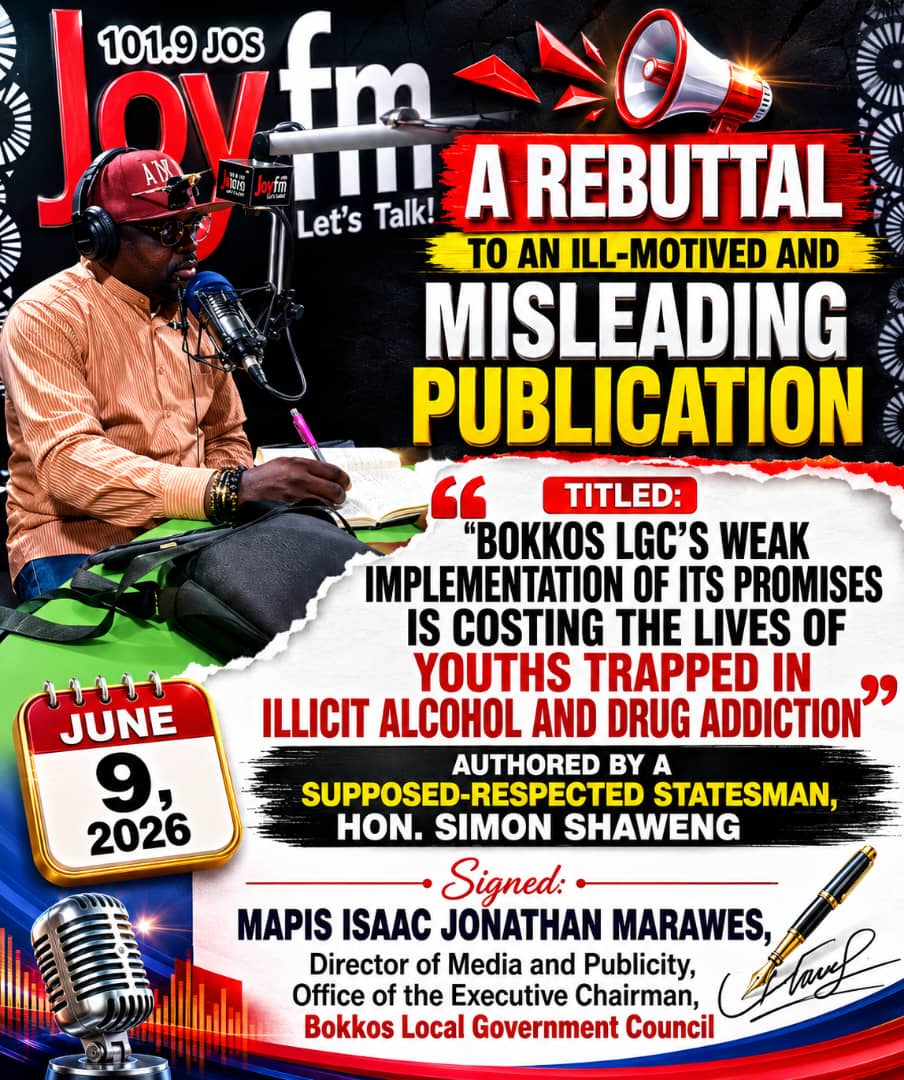
By Mapis Jonathan marawes.
*A REBUTTAL TO AN ILL-MOTIVED AND MISLEADING PUBLICATION TITLED: “BOKKOS LGC’S WEAK IMPLEMENTATION OF ITS PROMISES IS COSTING THE LIVES OF YOUTHS TRAPPED IN ILLICIT ALCOHOL AND DRUG ADDICTION”, AUTHORED BY A SUPPOSED-RESPECTED STATESMAN, HON. SIMON SHAWENG*
_JUNE 9, 2026/REBUTTAL MESSAGE/TO A MISLEADING PUBLICATION/Hon. Simon Shaweng/MARAWES/Director M&P/Office of the Executive Chairman/Bokkos LGC, Plateau State, Nigeria_
The attention of the Office of the Executive Chairman, Bokkos Local Government Council, has been drawn to a publication authored by Hon. Simon Shaweng and titled “Bokkos LGC’s Weak Implementation of Its Promises is Costing the Lives of Youths Trapped in Illicit Alcohol and Drug Addiction.” While every citizen reserves the constitutional right to express opinions on matters of public concern, it has become necessary to respond to the assertions contained therein so that silence should not be misconstrued as acceptance of the contents of the malicious epistle carrying the ill motive of the author.
First and foremost, the administration of the Executive Chairman, Hon. Amalau Samuel Amalau, remains unwavering in his commitment to safeguarding the lives and welfare of the people of Bokkos Local Government Area. Contrary to the misleading impression created by the author, this administration has not abandoned its responsibilities. Rather, it took the bold and proactive step of establishing a Taskforce on the Implementation of the Law Banning the Sales and Consumption of Illicit Drugs and Alcoholic Drinks to confront the menace head-on. The formation of the Taskforce was not a mere political gesture but a practical demonstration of the government’s determination to protect communities from the devastating consequences of substance abuse.
As a concerned statesman, Hon. Simon Shaweng ought to appreciate the complexity of the challenge he seeks to trivialize. If the Federal Government, with its enormous resources, statutory powers, sophisticated intelligence network, and the operations of the National Drug Law Enforcement Agency (NDLEA), has not completely eradicated the menace of illicit drugs and substance abuse across Nigeria, how then does he expect a local government administration to eliminate the problem overnight? Such expectations are not only unrealistic but also fail to reflect the practical realities associated with combating organized criminal activities involving drug trafficking, distribution, and consumption.
While the author acknowledged the establishment of the Taskforce by the local government administration, he failed to appreciate the enormous difficulties involved in executing such a mandate. The Taskforce cannot be present in every village, street, settlement, and household at the same time. Criminal elements involved in the sale and distribution of illicit substances often devise sophisticated means of evading law enforcement agencies. Even the NDLEA, despite years of sustained operations, arrests, intelligence gathering, and checkpoints across the country, continues to battle the menace. Therefore, it is unreasonable to expect immediate and total success from a local government task force operating within limited resources and jurisdictional constraints.
Hon. Shaweng’s recommendations, though seemingly attractive on paper, woefully fall short of practical realities. The suggestion that! checkpoints alone can effectively stop the importation and distribution of illicit substances it overlooks the fact that traffickers have consistently found ways to circumvent checkpoints across Nigeria. Yet, Illicit drugs continue to find their way into communities. r mass rehabilitation programmes ignores a fundamental reality: rehabilitation can only yield lasting results when the chain of supply and consumption is substan
In furtherance, it must be stressed that the fight against illicit drugs and alcohol abuse is not solely the responsibility of the government. It is a collective obligation that requires the active participation of families, religious institutions, traditional rulers, community leaders, youth organizations, schools, and civil society groups. Every individual involved in the sale, distribution, or consumption of illicit substances belongs to a family, worships in a religious community, and lives within a particular society. Therefore, all stakeholders must rise to the challenge instead of shifting the entire burden to the government while remaining passive observers. The question that must be asked is whether families, religious organizations, and community leaders are doing enough to discourage and report these activities within their respective constituencies.
Unequivocally speaking, the law banning the sale and consumption of illicit drugs and alcoholic drinks in Bokkos Local Government Area remains fully effective and enforceable. There is no intention whatsoever to repeal or weaken the provisions of the law. Any individual found violating the bye-law shall be made to face the full wrath of the law in accordance with the relevant legal provisions. The Taskforce on the Implementation of the Law has recorded significant achievements in enforcing compliance, creating awareness, and reducing the open display of illicit substances in many communities. While much remains to be done, the Taskforce deserves commendation rather than unwarranted condemnation. It must again be emphasized that no enforcement mechanism can achieve total success overnight, just as the NDLEA continues to grapple with the same challenge across the nation.
The administration of Hon. Amalau Samuel Amalau remains focused on delivering the dividends of democracy to the grassroots people of Bokkos Local Government Area. The Executive Chairman will not be distracted by unfounded accusations, political mischief, or attempts to undermine the genuine efforts of his administration. His commitment to infrastructural development, security, youth empowerment, community engagement, and the overall welfare of the people remains steadfast and unwavering.
Finally, while constructive criticism remains an essential component of democratic governance, public commentary should be guided by objectivity, fairness, and a genuine desire to promote the common good. Hon. Simon Shaweng, as a respected statesman, is encouraged to focus on constructive engagement and avoid making utterances capable of eroding his own integrity and diminishing the reputation he has painstakingly built over the years. The Executive Chairman is not engaged in any form of competition with Hon. Shaweng or any other individual. Rather, he remains committed to serving the people of Bokkos Local Government Area to the best of his ability and in accordance with the mandate entrusted to him by the electorate.
Signed:
MAPIS ISAAC JONATHAN MARAWES,
Director of Media and Publicity,
Office of the Executive Chairman,
Bokkos Local Government Council.